
What Makes a Curly Haircut Different (and Why It’s Worth It)
Why curly haircuts in New Westminster require different technique, training and pricing — and how the right cut transforms how your curls behave every day.
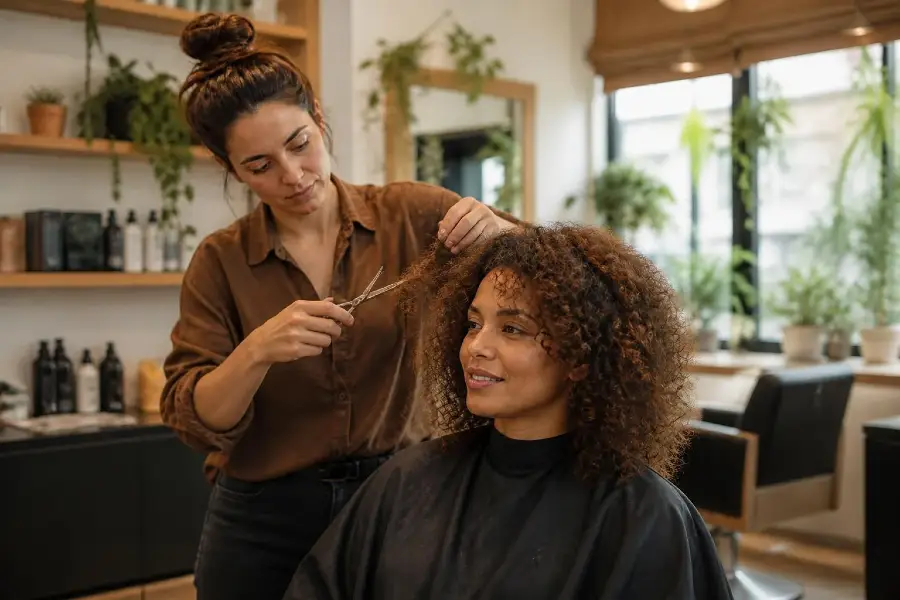
Why Curls Need a Specialist Cut — and What to Expect in the Chair
If you have curly hair, you’ve probably had this experience at least once. You sit down in a salon chair, the stylist runs a comb through your soaking-wet hair, snips it in a straight line across the bottom, and sends you home. Three days later, after your first wash, you realize one side is longer than the other, the layers don’t make sense, and your curls are doing things they never did before — usually triangle-shaped things.
This is the curly hair frustration that almost everyone with waves, coils or curls knows by heart. And it’s not because the stylist didn’t care. It’s because cutting curly hair well is a fundamentally different skill from cutting straight hair, and most stylists are never trained in it. Searching for a curly haircut in New Westminster is one of the harder beauty searches in the city — but when you find someone who knows what they’re doing, the difference is genuinely life-changing.
This article is about why curly haircuts are different, what should actually happen in the chair, and how to recognize a stylist who’s trained to do them well.
- Curly hair is shaped, not just trimmed — a true curly haircut works with how each curl actually falls, not how it lies flat.
- Most curly cuts happen on dry hair so the stylist can see the real curl pattern, length variation and natural fall.
- A good curly cut should make your wash-and-go easier, not harder — less product, less frizz, more shape.
- Curly hair needs a stylist with specific training. The price difference reflects skill, time and very different technique, not a surcharge.
Why Curly Hair Behaves So Differently
To understand why curly hair needs its own approach, it helps to understand what makes curly hair curly in the first place. The shape of every strand is determined by the shape of the follicle it grows from. Straight hair grows from a round follicle, wavy hair from a slightly oval one, and curly hair from an increasingly flattened or curved follicle. The more flattened the follicle, the tighter the curl.
That single biological difference creates a chain reaction. The natural oils your scalp produces have a harder time travelling down a curly strand, so the ends are almost always drier than the roots. Each curl has more surface area than a straight strand, so it loses moisture faster. And because curls coil rather than lie flat, a curly head of hair appears shorter than a straight head of hair with identical strand length — which is why a six-inch curl might only show up as a three-inch length when worn.
None of this matters until you pick up a pair of scissors. The moment you do, every one of these differences becomes critical.
Cutting straight hair is geometry — clean lines, even lengths. Cutting curly hair is sculpture — shaping a three-dimensional form so that every curl lands where it should.
Wet Versus Dry: The First Big Choice
The most visible difference between a curly cut and a traditional cut is whether the hair is wet or dry when it’s cut. Most traditional haircuts happen on saturated hair because it’s easier to see straight lines and create precision. For curly hair, that approach hides almost everything you need to see.
Wet curly hair stretches under its own weight. A curl that bounces up to your collarbone when dry can hang halfway down your back when wet. If your stylist cuts a clean line across your wet hair and sends you home, what looked like a polished cut in the chair becomes a chaotic, uneven shape once your curls bounce back into their natural pattern. Two strands cut to the same wet length will often dry to wildly different lengths because they spring back differently.
That’s why most well-trained curly stylists prefer to cut dry, or at least to do the bulk of the shaping dry. They want to see the curl in its natural state — the way it’ll actually be worn most days of the year. They cut curl by curl, evaluating how each one falls, and shaping the overall form to flatter the wearer’s face and the natural curl pattern. It’s slower, it’s more deliberate, and the result is dramatically different.
What Actually Happens in a Curly Cut
A proper curly hair appointment doesn’t start with scissors. It starts with a conversation. Your stylist should be looking at your hair the way an architect looks at a piece of land — assessing curl pattern, density, porosity, the way the layers fall, where it tends to expand, and where it lies flat. That assessment is the foundation of everything else.
The cutting itself often happens in sections, and often without much tension. Where a traditional cut might pull each section taut to create a clean line, a curly cut is gentler — the stylist lets each curl find its own resting position, then trims it where it naturally falls. Some curly methods involve cutting at angles inside the curl rather than straight across the bottom. Others work in carefully placed internal layers that reduce bulk without flattening the shape on top.
After the cut, the styling matters too. Many curly stylists won’t blow out a fresh curly cut — they want you to see what your curls actually do with a wash-and-go, because that’s how you’ll wear it. They’ll talk through how to apply your products, how to encourage your curl pattern at home, and what to expect as the cut grows out. It’s less a haircut and more a small course in your own hair.
The Training Curly Stylists Actually Get
Standard cosmetology programs spend most of their cutting curriculum on straight hair. Curly hair is often a single afternoon — sometimes less. Stylists who specialize in curls have almost always gone out of their way to add training afterwards, through methods like the Rezo Cut, DevaCurl certifications, the Ouidad carving technique, or other curl-focused systems. Each of those programs is its own school of thought, and most curly specialists draw from several.
You don’t need to know which method a stylist follows to find a good one. What matters is that they’ve trained beyond their initial education, that they’ve worked on a wide range of curl types, and that they can explain their approach in plain language. A stylist who can tell you why they’re cutting a certain section a certain way — and adjust based on what your specific curls are doing — is the stylist you want.
They ask questions before they touch your hair. They want to see how you usually wear it. And they’ll show you what they’re doing as they go, not just hand you a mirror at the end.
Why It’s Worth What It Costs
Curly haircuts almost always cost more than traditional cuts. That price difference isn’t a markup — it reflects time, skill and equipment. A curly cut often takes ninety minutes to two hours when you include the consultation, dry-cutting, refining, styling and education. The same stylist might do three or four standard cuts in that same window. The price simply reflects the chair time.
The other thing the price reflects is what you take home with you. A great curly cut changes how your hair behaves every day for the next eight to twelve weeks. Frizz goes down. Definition goes up. Products that used to do nothing suddenly work. You stop spending forty-five minutes wrestling your hair into submission every morning and start spending five minutes encouraging it. The cut quietly pays for itself in the time and product you stop wasting.
It’s the same calculation as the difference between a tailored suit and an off-the-rack one. Both technically cover you, but only one is actually built for your body. A curly cut is the tailored suit version of a haircut — built for your specific curl pattern, density and shape.
How Often Should You Get a Curly Cut?
Curly hair tends to look better between cuts than straight hair does, because curls hide the visual unevenness that straight hair telegraphs. Most curly clients can comfortably stretch to ten or twelve weeks between cuts, and some go even longer. That said, the ends of curly hair are where most of the dryness and damage live, so regular maintenance still matters. A quick refresh trim every twelve to sixteen weeks keeps the shape strong and prevents the ends from feeling crunchy.
Pairing your cuts with a regular deep hair treatment makes a meaningful difference too. Curly hair lives or dies by moisture, and a treatment between cuts keeps the curl pattern springy rather than tired. The plant-based Aveda Nutriplenish and Botanical Repair lines were built specifically for the moisture and bond needs that curly hair has, and they pair beautifully with a well-shaped cut.
What to Bring (and Skip) to Your First Curly Appointment
If you’re booking your first proper curly haircut, the appointment will go better if your hair shows up as itself. That means coming in with your normal wash-and-go, your usual products, and your everyday styling routine — not a flat-iron, not a fresh blowout, not a slicked-back ponytail. Your stylist needs to see what your curls actually do on a Tuesday, not what they look like at their most polished. Inspiration photos help, but pictures of curls similar to yours are more useful than pictures of someone with completely different texture.
Beyond that, come ready to talk about what frustrates you. The triangle shape. The flat top. The one side that always curls differently from the other. The frizz halo. All of those are things a trained stylist can address with cutting and styling adjustments — but only if you tell them what’s been driving you crazy.
Frequently Asked Questions
Why is a curly haircut more expensive than a regular haircut?
A curly cut typically takes ninety minutes to two hours and requires specialized training beyond standard cosmetology school. The price reflects the additional chair time and the technique involved — not a premium added to a standard service.
Should I straighten my hair before my curly haircut appointment?
No. Come in with your usual wash-and-go and the products you normally use. Your stylist needs to see your curls in their natural state to cut them well. If you’ve been straightening recently, give your hair a couple of washes to bounce back before your appointment.
How often do I need to come back for a curly cut?
Most curly clients comfortably go ten to twelve weeks between cuts, sometimes longer. The shape holds well as it grows, but refreshing the ends every three to four months keeps the cut feeling intentional and your curls feeling healthy.
Will a curly haircut make my hair look shorter?
Possibly — but in a different way than you might expect. Because curly hair coils, it always looks shorter than the actual strand length. A well-shaped cut often makes curls appear more defined and bouncier, which can look fuller and more flattering even at a similar length.
Our curly hair specialists cut, shape and coach waves, curls and coils so they behave beautifully every day. Book a consultation below.